
BTP INSIGHTS / GLOBAL PERSPECTIVE / ARTICLE 01
How people development drives lasting results
Why better business performance starts with understanding the work, developing capability and strengthening daily leadership.
People first. Progress that lasts.
The central idea
Training is an activity. Better performance is the goal.
A completed course is easy to count. A lasting change in how work is performed is much more valuable.
Many organisations invest in training, new processes and improvement programmes. Yet the benefits can fade when people return to familiar routines, standards are unclear or leaders lack the capability to reinforce new ways of working.
People development creates business value when it helps people perform work differently and more effectively, and when leaders make those changes part of everyday operations. That connection should be visible from the original business need through to evidence of sustained results.
01 · Diagnose before you prescribe
Start with the business need, then study the work
A request for training is not yet a diagnosis. A quality problem may reflect unclear standards, missing skills, equipment constraints, work design or leadership routines. Sending everyone on a course cannot resolve every cause.
Begin by agreeing on the result that matters. What is the current performance? What should it be? What happens at the place where the work is done? What do the people doing the job know about the barriers?
Observe actual work, compare it with the agreed standard, listen to employees and identify the underlying causes. Only then select the right combination of development and improvement approaches.
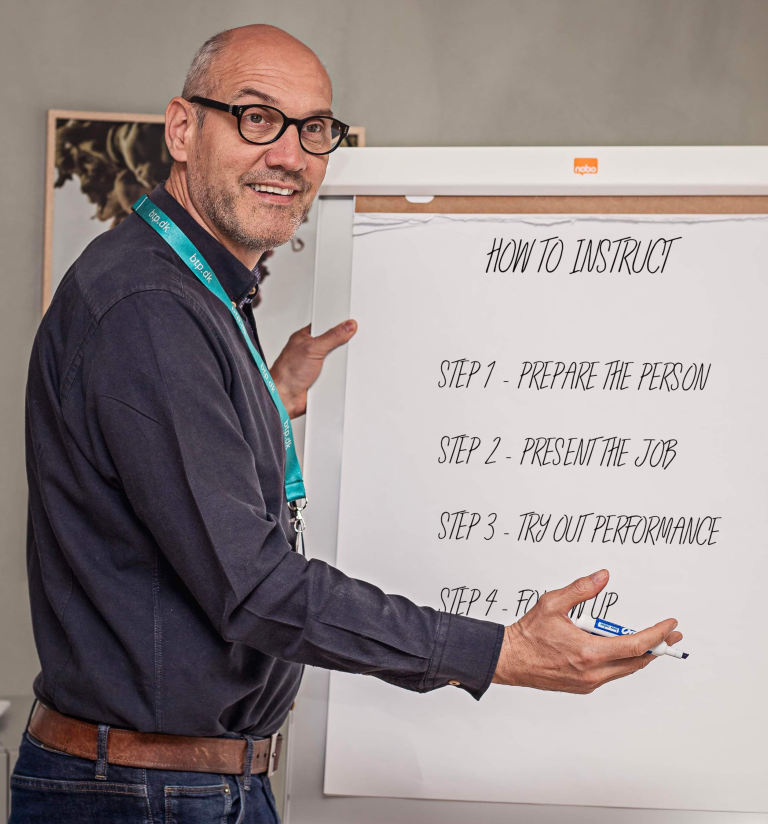
LEARNING WHERE WORK HAPPENS
Develop capability through practical work.
At BTP, learning connects to daily practice, real work and leadership routines that reinforce improvements. The focus is on building organisational capability, not merely delivering a course.
02 · Different needs, different approaches
Develop capability where it makes a difference
Training Within Industry (TWI) offers structured programmes for important workplace challenges. They are options within a wider enabling approach, not a prescribed sequence or a solution to every business problem.
TWI · JOB INSTRUCTION
Develop skills
Can people perform their jobs safely, correctly and conscientiously? Structured instruction makes important steps, key points and reasons clear, and builds reliable job capability.
TWI · JOB RELATIONS
Build trust and commitment
Can leaders establish good working relationships, recognise people as individuals and handle problems based on facts? The aim is stronger day-to-day leadership and cooperation.
TWI · JOB METODS
Improve the work
How can teams make jobs safer, easier and more effective? Job Methods helps people analyse job details and develop practical improvements using existing resources.
Choose the programmes that address the underlying causes. Combine them when needed.
Where the need calls for other capabilities or methods, the response should reflect that. Good diagnosis comes before selecting the tool.
The leadership foundation
Three foundational skills. One leadership system.
TWI Job Instruction, Job Relations and Job Methods are more than independent programmes. Together, the three classic core programmes develop complementary supervisor skills: instructing people, building effective working relationships and improving work.
Organisations can begin with one programme to address a specific performance need. Over time, developing all three skills across leaders creates a more balanced foundation for shared leadership routines, on which advanced leadership and improvement practices can build. This is a BTP perspective on capability development, not a claim that every organisation must implement all three at once.
03 · The BTP Work and People System
Connect business needs, people development and daily leadership
The BTP Work and People System connects business needs with daily work, people development and leadership. These five elements show how organisations can build capability, improve performance and sustain results. They complement BTP’s established Enabling Process.

Business need
Define the gap and intended result

Understand the work
Observe standards and causes

Build capability

Daily leadership
Practise, coach and reinforce

Evidence & results
04 · Make it part of daily work
Daily leadership is where learning becomes performance
Skills are built through instruction, practice and feedback. They are sustained when leaders clarify expectations, observe work, coach people, solve problems and check that the new practice remains in place.
BTP’s established Enabling Process translates this into three phases:
Get ready
Understand the current state, engage management, define the future state and prepare pilot areas.
Run pilot projects
Train the pilot team, practise and coach in real work, then evaluate what changed.
Cascade and sustain
Build internal trainers, roll out learning and keep improving without permanent external dependence.
These phases help organisations test a new way of working in practice before scaling it. The goal is to build the organisation’s own ability to improve, not a continuing reliance on external trainers.
05 · From learning to impact
Make the evidence chain visible
Attendance, training satisfaction and certificates tell us something about an activity. They do not by themselves demonstrate business impact. Build a credible chain of evidence, measure a baseline and check for other factors that may have contributed to the result.
Business need
Capability developed
Can people demonstrate the required skill?
New behaviours and work practices
Performance improvement
What changed in quality, safety, delivery or productivity?
Sustained business results
The chain is a way to structure questions and evidence. It does not establish causality on its own.
06 · Learning from clients
What does this look like in real organisations?
The examples below come from BTP’s published customer stories. They illustrate specific approaches and reported experiences, not results promised for every organisation.
Grundfos · Standardised work and leadership
Make quality part of the job
Grundfos reported that structured Job Instruction improved the completion of post-inspection forms, reducing avoidable follow-up work. The published story also describes Job Relations creating a common language for leadership and fact-based handling of problems.
Reported outcome: better completed inspection forms and more efficient quality control. No verified percentage is stated in the cited case.
Idealcombi · Onboarding and skills
Contribute from day one
Idealcombi describes structured training plans, dedicated job trainers and follow-up process confirmation for new employees. The published case reports that employees can begin contributing within their first two hours.
Reported outcome: new employees contributing less than two hours after starting on their first working day.
ConvaTec · Digital support for TWI JI
Support consistency at scale
BTP’s ConvaTec-related material describes combining TWI Job Instruction with Champ’s digital support for structured training. It illustrates how digital records and standardised workflows can help follow-up across teams and sites.
By combining TWI Job Instruction with CHAMP’s digital training support, ConvaTec strengthened structured onboarding and training consistency. ConvaTec reported a 40% increase in output.
07 · A practical leadership guide
Five questions to take back to your organisation
Choose one important performance gap. Bring these questions to the actual workplace with the people responsible for the work.
Develop people to improve the work. Improve the work to create lasting results.
LET’S EXPLORE YOUR CHALLENGE
What business result do you need to improve?
Discuss your challenge with a BTP Enabler and explore a useful starting point.
MORE FROM BTP INSIGHTS
Continue exploring the BTP approach

In this issue of The BTP Magazine, you’ll find real-life stories from leaders and organizations who are creating meaningful, measurable change — through people.
From structured training and frontline leadership to global learning cultures, each story reveals how small actions can lead to powerful results.
Get inspired, gain insight, and see how transformation really happens.
Explore the full magazine
See how organizations across industries turn challenges into long-term success — one mindset, one relationship, and one method at a time.